Private MRI scans in Hemel Hempstead
Hemel Hempstead grew out of an old market town into one of Hertfordshire's biggest towns, and for plenty of people here the week is built around a commute into London. Fitting a scan around that is rarely simple. An MRI uses magnets and radio waves to build detailed pictures of joints, discs, ligaments and other soft tissue, which makes it a useful next step when knee or back pain refuses to settle. Booking privately cuts out the wait.
Hemel Hempstead private MRI scan costs
Private MRI scans start from £130 in Hemel Hempstead. That price covers more than the scan itself, taking in a consultation with a clinician and the referral that follows it. What centres charge varies, so run a search and compare the ones closest to you.
How do I book a private MRI scan in Hemel Hempstead?
No GP referral is needed. Put in your postcode, or work across the map, and weigh up the centres that come back on price and on what each one offers. Choose one, then fill in a short booking and safety form covering your medical history and the reason for the scan. Payment confirms the appointment. We handle everything after that.
Why book with us?
We run the largest medical imaging network in the UK, with hundreds of locations across the country and no referral required. Booking online takes minutes, a clinician calls you within hours, and the scan itself happens within days. Waiting lists do not come into it, so the timing and the place are yours to choose. Results come through digitally, ready to share with your healthcare professional.
Preparation for MRI scans
Most MRI scans ask very little of you beforehand, although you may occasionally be told not to eat or drink for a period before the appointment. Dress in something soft and comfortable with no metal fastenings on it, so nothing with buttons, toggles or zips. Some people are asked to change into a gown instead. The magnets inside the scanner are powerful and react to metal, which is why glasses, jewellery, watches, belts, wallets, phones and other personal items have to be left outside the scanning room. An implanted medical device, a pacemaker for instance, can mean extra preparation is needed to keep you safe. Whatever applies to you will be explained ahead of the day. Scans using contrast also call for recent blood test results showing how well your kidneys are working, since the kidneys are what clear the gadolinium contrast agent afterwards.
The procedure
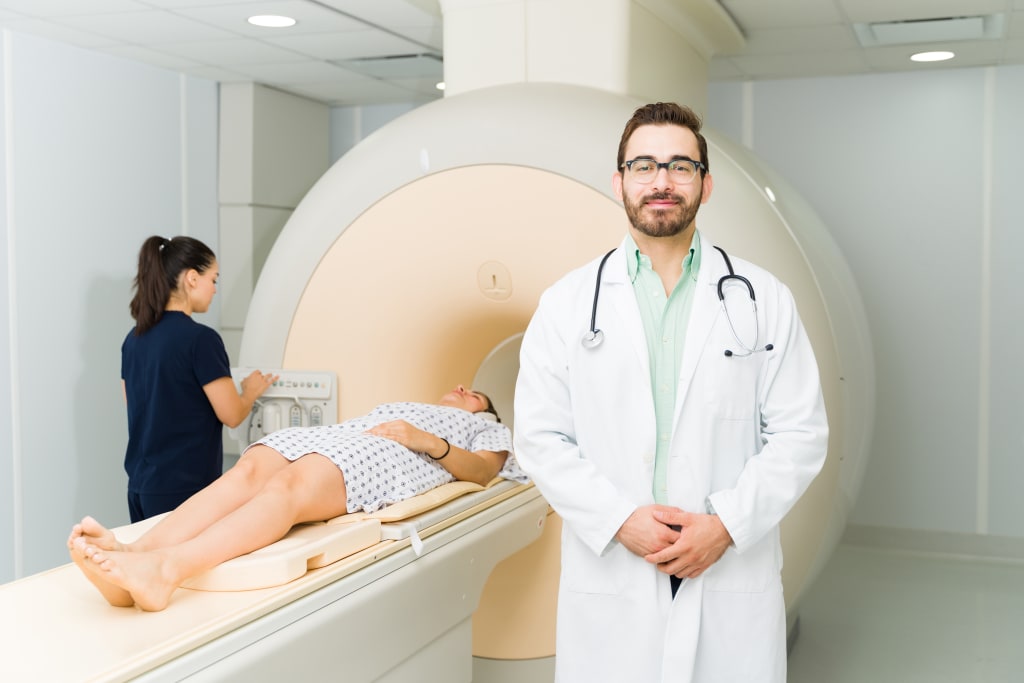
Radiographers, trained specifically in this kind of imaging, carry out the scan and will talk you through what happens before anything starts. You lie still on a flat bed, which slides into the scanner, a large machine shaped like a doughnut. Anywhere between 15 and 90 minutes is normal, and the area being looked at decides where in that range you land. Contrast, where it is required, goes in through an IV. Expect noise. Music is usually an option, and the radiographers speak to you through headphones as the scan runs.
How long does it take?
Anywhere from 15 to 90 minutes. The number of body areas being imaged makes the biggest difference, and a scan that uses contrast will add to it. Your clinician and the imaging centre you pick will confirm what to expect for your own appointment.