
Key takeaways:
-
A cone beam CT (CBCT) scan is a highly detailed CT scan used by dentists to analyse the health of the teeth and jawbones, as well as the soft tissues of the mouth and lower face.
-
CBCT scans use a low dose of radiation, and they’re considered safe for most people.
-
Your dentist may recommend a CBCT if they want to plan complex dental surgery or to diagnose a health condition affecting the teeth, jaw joint or sinuses.
-
Private CBCT scans with Scan.com are usually available within a week, and you’ll have your results in days.
A cone beam computed tomography (CBCT) scan is an imaging technique that produces detailed X-ray images of your mouth and teeth. They’re used to plan complex dental surgery and evaluate problems with the jaw.
What is a Cone Beam CT Scan?
A cone beam is a type of CT scan used by dentists and orthodontists to take 3D images of the mouth, teeth and jawbones. The images produced allow dental specialists to view the alignment of your teeth (including the roots and any hidden decay and cysts), your jaw joint, soft tissues and the blood vessels, nerves and sinuses.
CBCT scans produce more detailed images than standard dental ‘bite’ X-rays that focus on one or two teeth.
Quick and painless, a cone beam CT has a lower radiation dose than a regular CT scan, making it safer. They’re usually performed in a specialist imaging centre, as the required scanning machine isn’t normally found in a regular dental practice.
How Does a CBCT Work?
CBCT scanners work by emitting a single cone-shaped X-ray beam from one side of the machine, which is picked up by a detector plate on the other.
During the scan, the arm of the machine rotates around your head, taking multiple two-dimensional images. In one rotation, up to 200 images are taken and then combined to create a three-dimensional image that your dentist can use to assess the health of your mouth and jaw.
How is a CBCT Dental Scan Different from an X-ray?
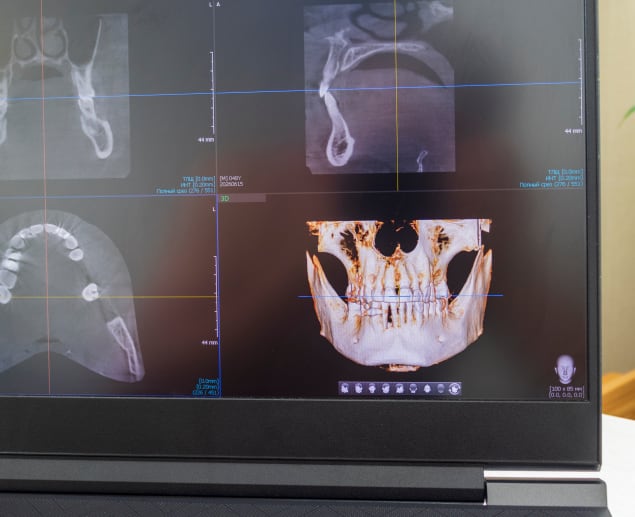
A CBCT scan produces three-dimensional images of the whole mouth. The resulting image is a digital recreation of your teeth, jawbone, soft tissues, nerves and sinuses. Roots, root canals, internal decay and cracks are all clearly visible.
Your dentist can electronically rotate and move the final image to view your mouth from multiple angles and slices, and use it to measure and analyse its parts in great detail.
CBCT images are used to plan complex dental procedures and diagnose conditions affecting the mouth and jaw. For example, a cone beam CT for implants will help your dentist make sure there’s enough space in your gum for an implant and ensures when it’s fitted, it won’t touch a nerve.
Conversely, a flat ‘bite’ X-ray that you might’ve had at your dentist’s surgery creates flat, two-dimensional images of specific parts of the mouth. They’re used in standard dental practice to detect small cavities and monitor bone loss and gum disease.
Which Dental Scan Do I Need?
Your dentist will let you know if you need a CBCT scan or a normal X-ray, but here’s a guide to CBCT vs dental X-rays.
In summary, if you need complex surgery or tooth realignment, or you have a suspected health condition affecting your mouth, jaw or sinuses, your dentist will recommend a CBCT. Dental X-rays are more routine and are used during dental check-ups to detect cavities and gum disease.
Why Do I Need a Cone Beam CT Scan?
Dentists use CBCT scans to help plan oral surgery and orthodontic procedures, and to diagnose conditions affecting the teeth, jaw and sinuses. Your dentist may recommend that you have a cone beam dental scan to:
-
Assess the density, shape and size of your jawbone to plan dental implant surgery
-
Map the roots and nerves to help plan wisdom tooth extractions
-
Assess impacted teeth
-
Plan complex tooth realignment and orthodontics
-
Evaluate the health of the jaw joint to help diagnose conditions such as temporomandibular joint disorder that can cause stiffness, pain and clicking in the jaw
-
Assess jaw fractures
-
Analyse the teeth, bones and soft tissues prior to reconstructive surgery
-
Assess the sinuses if they suspect you have sinusitis or nasal polyps
-
Diagnose cysts and tumours
Is a CBCT Scan Safe?
All X-rays and CT scans use ionising radiation. Being exposed to ionising radiation, such as when having a CT scan, means you have a very small increased risk of developing cancer in your lifetime. This risk is very small, and doctors only perform X-rays and CT scans when necessary, and the benefits of having a scan outweigh the risks of not having one.
It’s important to take the risk of radiation exposure from scans into context. Background radiation exists in the environment we live in, meaning that we’re exposed to low levels of radiation all the time.
A cone beam CT radiation dose is higher than that of a standard oral X-ray, but lower than that of a standard CT scan.
The exact radiation dose from an X-ray or CT scan will depend on your size and the scanner used. But it’s thought that a standard CT of the jaw is roughly equivalent to 60 to 150 days of background radiation exposure, while a CBCT of the jaw is much lower and roughly equivalent to 5 to 30 days.
What Happens During a CBCT?
A CBCT requires no special preparation, but let your medical team know if you’re pregnant or there’s a chance you might be. You don’t need to fast (when you avoid eating and drinking) prior to a dental cone beam scan, and you can take any regular medications as normal, unless otherwise instructed by your dentist.
Avoid wearing clothing that fits tightly around your neck, such as a polo neck jumper, scarf or tie, to your appointment.
Metal objects can interfere with image quality. Therefore, make sure you’ve removed any necklaces, earrings and hair clips before your appointment. If you use glasses, you can wear them to your appointment, and you’ll be asked to remove them just before the scan. The same goes for dentures and hearing aids.
CBCT scans are quick, and your appointment will take around 15 minutes. This includes the time to get you into position; the actual scan only takes a few minutes. You’ll be asked to sit or stand and remain still while the scan takes place.
A medical professional, called a radiographer, will position your head on a rest and will let you know when the scan is about to start. They’ll ask you to try not to swallow or move your jaw during the scan.
The scanning machine moves slowly around your head, taking images as it goes. It takes around a minute to complete a full circle. You may need more than one scan, but you’ll be able to swallow and take a breath between each one.
If you think you might not be able to remain still, or you struggle in a confined space, let your radiographer know.
After your scan, you can return home and to your normal duties straightaway. You can continue to eat and drink as normal.
Finding a Private Cone Beam CT Scan
Private dental CBCT scans with Scan.com start at £195 and are easy and fast to book. Book yours today, and you could have your results in days. Once you have your scan images and report, you’ll be able to share them electronically with your dentist.
References
Radiological Society of North America (RSNA) and American College of Radiology (ACR). (n.d.). Dental Cone Beam CT. Radiologyinfo.org. https://www.radiologyinfo.org/en/info/dentalconect
Radiological Society of North America (RSNA) and American College of Radiology (ACR). (n.d.). Radiation dose. Radiologyinfo.org. https://www.radiologyinfo.org/en/info/safety-xray
FAQ
Is a CBCT scan safe?
Yes, CBCT scans are considered safe for most people as the radiation exposure is low.
How long does a CBCT scan take?
The scan itself takes a few minutes, but you can expect your appointment to last around 15 minutes.
How long until I get my results?
You can expect to receive your results within a few days.
CBCT vs dental X-ray: what do they show?
A CBCT scan creates a 3-D image of the whole mouth, including the teeth, jawbones, soft tissues, nerves and sinuses. An X-ray produces a 2-D image of a specific section of the mouth, showing the teeth and jawbones.