
Key takeaways:
-
A pantomogram (OPG) scan is a panoramic X-ray of the teeth and jawbones that dentists use to plan dental work and orthodontic procedures.
-
OPG scans use a low dose of radiation, and they’re considered safe for most people.
-
Your dentist may recommend an OPG if they want to plan tooth extractions, assess impacted wisdom teeth or investigate potential infections or abscesses.
-
Private OPG scans with Scan.com are usually available within a week, and you’ll have your results in days.
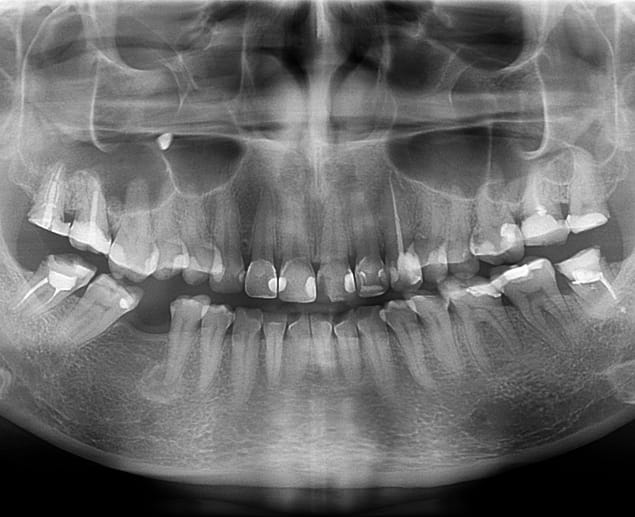
An orthopantomogram, or OPG, is a two-dimensional panoramic dental X-ray that shows your upper and lower jawbones and teeth in a single image. They’re used by dentists to view your teeth and their position in your gums and jawbone.
OPG Panoramic Dental X-rays Explained
Sometimes referred to as a panoramic dental X-ray or an orthopantomogram, an OPG is a dental X-ray that produces a wide image of the mouth, including the teeth, wisdom teeth and jawbones.
Your dentist may recommend an OPG scan to analyse the position of your teeth and the health of your jawbones. OPGs highlight hidden structures and abnormalities, such as teeth still growing under your gums, impacted wisdom teeth pushing against other teeth as they grow and unusual bone growth. They also allow dentists to see areas of bone loss, fractures, infections, cysts and tumours.
Quick and painless, OPGs use a relatively low dose of radiation and are considered safe for most people. OPGs are different from a standard ‘bite’ X-ray that only focuses on one or two teeth at a time. As they’re more advanced, they’re usually carried out at a specialised imaging centre, rather than at your normal dental practice.
How Does an OPG Dental X-ray Work?
X-ray machines work by sending a low-dose X-ray beam painlessly through the body to a detector plate on the other side.
During the scan, a machine arm moves around your lower face from ear to ear in a semicircle. X-rays are emitted from the machine arm, and the machine converts the X-ray signals into a black-and-white image.
OPG vs CBCT: What’s the Difference?
An OPG produces a panoramic, two-dimensional image of the teeth and jawbones.
A CBCT, or cone beam computed tomography, scan, is a different type of dental scan that creates a three-dimensional image of the mouth and lower face. CBCT images include the teeth (including those within the gums), jaw bones, jaw joint, soft tissues, nerves and sinuses.
OPG is used in routine dental and orthodontic assessments, and CBCT is used to help dentists plan complex dental surgery, map the nerves and diagnose disorders affecting the mouth and jaw.
CBCT images can be viewed from multiple angles and slices. This allows dentists and oral surgeons to get an extremely precise view of the mouth and jaw, which isn’t necessary for routine dental work and standard orthodontic procedures.
Dental X-ray Types
There are three dental X-ray types: a standard bite X-ray, a panoramic dental X-ray (OPG) and a cone beam CT (CBCT). Your dentist will inform you which one you need.
OPG vs CBCT: What Do I Need?
If you’re having fairly extensive dental work or your dentist needs a panoramic view of your whole mouth and tooth alignment rather than just focusing on one or two teeth (when a standard bite X-ray will suffice), they’ll recommend an OPG. If you’re having detailed, complex dental work or investigations, they’ll recommend an CBCT.
Why Do I Need a Pantomogram?
Dentists use OPG scans to visualise your teeth, including the roots and their alignment in your jaw, at the same time. This is useful when they're planning routine dental work and orthodontics. They may recommend an OPG scan to:
-
Assess impacted wisdom teeth
-
Get an overview of the mouth before removing teeth
-
Look for signs of infection, cysts or abscesses in the gum that could be causing bone or tooth loss
-
Plan orthodontic treatment, such as brace fitting
-
Investigate jaw pain or clicking to help diagnose temporomandibular joint disorder
-
Assess fractures and injuries to the mouth and jaw
Is an OPG Scan Safe?
All X-rays use radiation, and an OPG is no different. Background radiation exists in the environment, and we’re exposed to it daily. Having an X-ray exposes us to more than normal, which means a very slightly increased risk of developing cancer later in life.
But taken in context, an OPG scan will expose you to the equivalent of around 2 to 5 days of background radiation. This is low compared with a standard chest X-ray, which exposes you to about 3 to 10 days of background radiation, or a CT scan of the head, which is equivalent to about 1 year of background radiation.
Therefore, OPG scans are considered safe, and the benefits far outweigh the risks.
What Happens During an OPG?
You don’t need to do anything special to prepare for an OPG scan, but tell your dentist if you’re pregnant or there’s a chance you might be. There's no need to fast (when you avoid food and drink), but brush and floss your teeth prior to your appointment.
Metal objects, such as necklaces, earrings and hair clips, will interfere with X-ray images, so avoid wearing them to your appointment. If you use glasses or a hearing aid, you’ll be asked to remove them just before the scan starts. If you wear dentures, your dentist will let you know if you need to remove them before your scan.
A specialist medical professional called a radiographer will conduct your scan. They’ll position you in a seat and place your head on a chin rest. You’ll be given a sterile plastic mouthpiece to bite down on to keep your mouth and jaw in alignment. You’ll need to keep still, and you’ll have forehead support and handgrips to help you do so.
The X-ray machine moves around your lower face in a semicircle, taking X-rays as it passes. The process takes less than 30 seconds, and the images are then collated to produce a single, panoramic two-dimensional view of your mouth.
Let your radiographer know if you think you might struggle to remain still. OPG scans are painless, and you won't feel anything during your scan. You’ll be able to return home and to your normal duties straight away.
Finding a Private OPG Dental X-ray
Private OPG X-rays with Scan.com start at £80, and appointments are usually available within a week. You’ll have your dental scan images and report within a few days, and you’ll be able to share them electronically with your dentist.
References
Mansbridge, P. (2025, October 23). What are OPG and CBCT scans and why you may need one? https://www.toothlondon.co.uk/annasblog/what-are-opg-and-cbct-scans-and-why-you-may-need-one
Seashells. (2024, February 16). How Much Dangerous Radiation are you Exposed to When Having Dental X-rays Taken? - 92 Dental. 92 Dental. https://92dental.co.uk/much-dangerous-radiation-exposed-dental-x-rays-taken/
FAQ
Is an OPG safe?
Yes, OPG scans are considered safe as they use very low doses of radiation. However, as a precaution, let your dentist know if you’re pregnant.
How long does an OPG take?
The scan itself only takes 20 to 30 seconds, but you can expect your appointment to last around 15 minutes in total.
OPG vs CBCT, which scan do I need?
Your dentist will recommend an OPG if you’re having routine dental or orthodontic work. If you’re having extensive, complex dental surgery, they’ll recommend a CBCT.