Back pain is a common reason for getting an MRI scan. If you find yourself suffering, your back pain could be caused by a herniated, slipped, or bulging disc.
This guide will tell you all you need to know about slipped disc MRI scans, what they can show, and how to get one.
What are discs in the spine?
Your spine is made up of 33 bones (called the vertebrae) stacked on top of each other, and between each of those bones are round, spongy tissues called discs (short for intervertebral discs) that perform three main functions:
-
Absorb shock and resist compression.
-
Maintain stability in the spine.
-
Allow frictionless movements of the vertebrae.
Each intervertebral disc comprises a tough outer shell called the annulus fibrosus that forms a ring around a soft, gelatinous centre called the nucleus pulposus. And at every juncture where the spinal bones and discs meet are ligaments that keep the discs in place, and spinal nerves that connect to different body parts.
What is a herniated disc?
A herniated disc happens when the nucleus pulposus (soft centre of the disc) protrudes and eventually pushes out through a tear in the outer shell. This displacement can press on a spinal nerve, causing inflammation and several pain symptoms.
Traumatic injury caused by car accidents, contact sports, and hard physical labour is the leading cause of disc herniation. Still, it can also result from simple wear and tear associated with ageing. It typically affects the lower back or neck region and, in some rare cases, the upper back.
Due to risk factors, including age, smoking, sedentary lifestyle, bad posture, poor nutrition, being overweight, and even genetics, disc changes—such as the gelatinous core losing much of its water content—are bound to happen. These changes are different for everyone and may result in disc degeneration and a bulging or herniated disc [1].
What are the main symptoms of a herniated disc?
If you have a herniated spinal disc, you may experience:
-
Pain at the site of the affected disc
-
Long-term, or chronic back pain, most commonly in the lower back
-
Pain that gets worse at night or after sitting or standing for long periods
-
Tingling, burning or numbness in your shoulders, back, arms or legs
-
Difficulty when bending over or straightening up
-
Muscle weakness
-
Nerve pain in the hips, buttocks or legs caused by sciatica
Suppose a herniated disc(s) in the lower back compresses the nerve roots at the end of the spinal cord. In that case, a person might also experience a condition known as the cauda equina syndrome, characterised by loss of bladder or bowel control, trouble balancing, and progressive reflex loss in the lower extremities [6].
Slipped disc vs Herniated disc: Is a herniated disc the same as a slipped disc?
Yes! A slipped disc can also be referred to as a herniated disc. Both terms describe a condition where the intervertebral disc—or a part of it—slips out of place.
Difference between bulging disc and herniated disc
Many people are confused about the difference between bulging disc and herniated disc because they share similar symptoms. Moreover, some health practitioners often use both terms interchangeably.
Getting a proper diagnosis starts with knowing the differences and similarities between the two.
Herniated disc vs bulging disc: Is a bulging disc a herniated disc?
The difference between bulging and herniated disc is that in a bulged disc, the soft, gel-like centre doesn’t push out through a tear in the tough, flexible outer wall. Instead, it somewhat deflates or flattens out.
Bulged discs develop quite differently. Our discs deteriorate and degenerate with age. As this happens, the gelatinous centre of a disc loses its water content, reducing pressure within the disc’s core. Consequently, it gradually loses its plumpness, sags, and can press outward under the weight of the adjacent bones. This can result in a fairly even bulge around a disc’s circumference or along a small portion of it.
Suppose you still need help understanding the difference between herniated and bulging disc or fear you might confuse both later. Do this:
Picture the herniated disc as what would happen if you pressed on a jam doughnut and the bulging disc as a deflated car tire or a hamburger with a patty slightly larger than its buns.
Keep in mind that you can refer to a herniated disc as a “bulging,” “slipped,” or “ruptured” disc, but a bulging disc cannot be labelled as herniated. If left untreated, a bulging disc can progress to become herniated if its outer wall tears and the soft centre leaks out.
Diagnosing a herniated disc
If you have symptoms of a herniated disc, your GP and specialist doctors will organise a range of tests and investigations that will help them diagnose or rule out the condition.
-
Physical examination - Your doctor will examine your back and spine to assess your pain level. They’ll also perform some muscle strength tests and check your reflexes.
-
Neurological examination - You may be referred to a neurologist if you’re experiencing chronic pain caused by nerve damage.
-
Symptom assessment - Your medical team will assess your symptoms and decide if they think you need further investigation to diagnose or rule out a herniated disc.
-
Imaging referral - If appropriate, they’ll organise a referral for spinal imaging.
-
MRI scan - An MRI is a type of spinal imaging technique that creates detailed images of the spine and surrounding structures.
-
Image interpretation - A consultant radiologist will interpret your MRI images and write a report on their findings.
-
Diagnosis confirmation - Your doctor will use the radiologist's report to confirm or rule out a disc herniation.
-
Differential diagnosis exclusion - If your symptoms are being caused by something other than a herniated disc, such as a fracture, muscle strain or degenerative disc disease (common in older patients), they’ll either make a diagnosis or suggest further tests.
What is an MRI scan and why is it used for slipped discs?
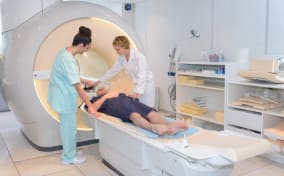
MRI is short for magnetic resonance imaging. It is an imaging test that uses a magnetic field and radio waves to generate signals from the body and process them into clear, detailed images of its internal structures. It is non-invasive, painless, and poses no radiation risk.
An MRI scan has proven highly accurate in presenting a detailed image of any damage, including disc herniation, inflammation, tumours, osteophytes (bony overgrowths), abscesses, hematoma (blood clots), and more, in every corner of the spine. It has a 97% accuracy of confirming a suspected disc herniation in the lumbar spine (lower back) region [2].
You can rest assured that if the MRI doesn’t detect the presence of a herniated disc, it can still help identify the underlying cause of your painful symptoms.
Types of MRI for a herniated disc
Doctors use a range of MRI scans to diagnose a herniated disc. Which one you have will depend on your symptoms, what part of your back is affected and your medical history.
-
Standard spine MRI - A standard spinal MRI performed while you’re lying down flat on a medical table that moves into the scanning machine.
-
T1-weighted MRI - MRI technology used during a standard spine MRI to differentiate between bone, ligaments and fat on the MRI images.
-
T2-weighted MRI - MRI technology used to visualise fluids such as cerebrospinal fluid and the spongy disc material leaking from a herniated disc. During a standard spinal MRI scan, your medical team will take images using both T1-weighted and T2-weighted spinal imaging techniques.
-
MRI with contrast - An MRI performed after a contrast dye has been injected into a vein, which helps to better highlight certain structures on the MRI images.
-
Upright (weight-bearing) MRI - An MRI performed while you're standing in a special MRI scanner that can detect smaller disc herniations that might be hidden while you’re lying down.
-
High-field (3T) MRI - Superior MRI spinal imaging technology used to create high-resolution images of the discs, soft tissues, disc material and nerves.
What does a herniated disc look like on an MRI image?
The first thing you would notice when observing a herniated disc MRI image is the exact location of the hernia. The hernia usually presents as a contrasting spot in the MRI; you will see how far the disc protrudes and presses the surrounding spinal nerve.
A herniated disc can look larger and darker than other healthy discs on an MRI image.
How an MRI Scan detects a herniated disc
An MRI uses radio waves and a strong magnetic field to temporarily disrupt the hydrogen atoms in the body. When hydrogen atoms realign, they release energy, which is detected by MRI imaging computers and converted into an image. A bulging disc that’s leaking disc material will show up in a different intensity than the healthy adjacent vertebrae.
Where can I get a slipped disc MRI scan near me?
Getting an MRI scan for slipped discs near you is easy when you can access the UK’s largest network of scanning centres. With over 150 thoroughly vetted options, you can book a private MRI scan within your budget, near your location, and at your convenience. No GP referral needed. No long wait times. No boring paperwork.
On booking, you will get on-demand access to an expert clinician team who will provide personalised guidance before your scan and, if necessary, arrange a post-scan consultation call to explain the information in your test reports and slipped disc MRI images.
Prognosis and treatment
Treatment for a slipped disc ranges, depending on the severity and how physically demanding your lifestyle is. Treatment options include rest, pain management medications, physiotherapy to strengthen back muscles, lifestyle changes to avoid excessive strain on your back, and surgery.
Surgery for a herniated disc also ranges, depending on the severity. Options include minimally invasive techniques to remove the affected part of the disc and any protruding bony structures on the affected or adjacent vertebrae, as well as artificial disc replacement and nerve root compression to relieve pain caused by nerve damage.
With the right diagnosis, treatment and lifestyle changes (such as regular strengthening exercises, safe lifting techniques and maintaining a healthy weight), many patients fully recover from a herniated disc
How is a slipped disc treated?
Acute slipped disc pain can resolve by itself within 6 to 12 weeks without treatment. The key is conservative management, which involves adequate bed rest, physical therapy, and over-the-counter pain medications (such as ibuprofen or acetaminophen).
If your herniated disc symptoms are persistent and severe, you might be prescribed medications such as muscle relaxants or corticosteroids.
Additionally, steroid injection for slipped disc has proven to be a clinically effective treatment method for lower back pain associated with disc herniation [7]. We understand that the word ‘steroid’ may seem daunting at first. Hence, we have expert spinal specialists on board to discuss the available injection options and all their benefits for your unique condition. Book a guided injection to speak with one. You can receive your treatment on the same day as the consultation.
In cases where conservative treatments and medications fail to provide relief or when there is significant nerve compression leading to severe symptoms such as weakness or loss of bladder or bowel control, surgery may be considered. Surgical options for a slipped disc include discectomy (removal of the herniated portion of the disc), laminectomy (removal of part of the vertebral bone), or spinal fusion (joining two or more vertebrae together with bone grafts or metal hardware).
Want to get to the root cause of your back pain already? Book a private MRI scan for slipped disc today to get a faster diagnosis and start your treatment journey.
FAQs
Can a chiropractor diagnose a slipped disc?
A chiropractor can diagnose a slipped disc by conducting a thorough physical examination; it helps them understand the severity of the pain (i.e., the symptom).
However, to confirm the diagnosis and determine the exact location of the slipped disc, assess how far the herniation has progressed (i.e., the root cause), and develop a comprehensive treatment plan, they will need to refer to the detailed images of your spine provided in your herniated disc MRI report.
Do I need a referral for an MRI?
You don’t need a referral to have a private MRI scan; you can book directly with Scan.com. If you’re waiting for an MRI scan with the NHS, you will need a referral from your GP or specialist. They will send it to your nearest scanning centre, which will then contact you with an appointment.
Can an MRI miss a herniated disc?
An MRI scan is considered the gold standard for diagnosing a slipped disc. However, in a small number of cases, an MRI may miss a minor or difficult-to-spot herniation. A standing MRI is often used to help reduce the risk of missing a smaller or hidden herniated disc.
Is an MRI safe?
Yes, MRI scans are considered safe for most people. Metallic objects cannot be taken into an MRI scanner. If you have any metal inside your body, such as implants, shrapnel or bullets, speak to your doctor before your appointment.
How accurate is a herniated disc MRI?
An MRI scan is highly accurate at detecting a herniated disc and is considered the gold standard in spinal imaging.
References
-
(n.d.). Wikipedia. Retrieved March 11, 2024, from https://www.cognitiveneuro.org/SafetyReadings/UCSFMRSafety.pdf
-
Cauda Equina Syndrome Due to Lumbar Disc Herniation: a Review of Literature. (n.d.). PubMed. Retrieved March 11, 2024, from https://pubmed.ncbi.nlm.nih.gov/29341941/
-
Effectiveness of Epidural Steroid Injection Depending on Discoradicular Contact: A Prospective Randomized Trial. (2023, February 19). NCBI. Retrieved March 11, 2024, from https://www.ncbi.nlm.nih.gov/pmc/articles/PMC9962306/
-
Lumbar Disc Herniation - StatPearls. (n.d.). NCBI. Retrieved March 11, 2024, from https://www.ncbi.nlm.nih.gov/books/NBK560878/
-
MRI is safe for most people with pacemakers and defibrillators. (2018, January 1). Harvard Health. Retrieved March 11, 2024, from https://www.health.harvard.edu/heart-health/mri-is-safe-for-most-people-with-pacemakers-and-defibrillators
-
Thomas, S. (2022, January 7). Case series demonstrating in vivo MR safety of stainless steel (Chinese/Ring) IUDs. NCBI. Retrieved March 11, 2024, from https://www.ncbi.nlm.nih.gov/pmc/articles/PMC9461733/
-
Velnar, T. (n.d.). A Brief Review of the Degenerative Intervertebral Disc Disease. NCBI. Retrieved March 11, 2024, from https://www.ncbi.nlm.nih.gov/pmc/articles/PMC7007629/