
Key Takeaways
-
Deep vein thrombosis (DVT) is a serious condition caused by a blood clot forming in a deep vein, usually in the leg.
-
Symptoms include pain, swelling, redness and heat in the affected area.
-
Blood clots in the legs can travel to the lungs and cause a pulmonary embolism that requires urgent medical attention.
-
DVT is diagnosed using an ultrasound scan to assess blood flow in the deep veins.
-
People with risk factors for developing DVT, such as being overweight, being immobile, smoking or having varicose veins, can benefit from a diagnostic DVT ultrasound scan to help detect potential problems before they become serious.
Deep vein thrombosis is a serious medical condition that’s detected with an ultrasound scan in an emergency situation. But diagnostic ultrasound scans performed before symptoms become serious can also identify potential problems sooner. This allows patients to make changes that can help prevent a dangerous health condition from developing.
What is Deep Vein Thrombosis (DVT)?
Deep vein thrombosis, known as DVT, is a serious condition caused by a blood clot forming in a major, or deep, vein, most commonly in the leg. These blood clots affect blood flow in the leg, causing symptoms such as pain, swelling and redness.
Blood clots can also travel through the body to the lungs, potentially causing an extremely dangerous condition called pulmonary embolism. A pulmonary embolism occurs when a blood clot blocks blood flow to the lungs.
Who Needs a DVT Scan?
Doctors use ultrasound scans to diagnose deep vein thrombosis when a patient has symptoms. Treatments are then given to help prevent the symptoms from worsening.
A DVT ultrasound scan can also be beneficial if used early, if you have risk factors for DVT. Having risk factors for DVT means that there are certain factors that can increase your risk of developing blood clots. These include:
-
Being overweight or obese
-
Smoking
-
Being over 60 years old
-
Taking the contraceptive pill or HRT
-
Having previously had DVT
-
Having varicose veins
-
Having heart failure
-
Having certain types of cancer
If you’re concerned you may be at risk of developing deep vein thrombosis, having a DVT ultrasound can help your doctor assess your risk, and if necessary, suggest changes and treatments that can help reduce your risk factors.
Symptoms
Deep vein thrombosis most commonly affects the deep veins of the legs, usually in one leg, very rarely both at the same time. Blood clots and the symptoms of DVT can also form in the arms or stomach area, but this is less common. Symptoms of DVT in the leg include:
-
Throbbing pain in the calf or thigh
-
Leg swelling
-
Redness or darkening of the skin of the leg, which might be harder to spot if you have black or brown skin
-
Skin that feels warm around the affected area
-
Sore, swollen or hardened veins in the leg
If you have symptoms of DVT, request an urgent appointment with your GP, call the non-emergency NHS helpline on 111 or check your symptoms using NHS 111 online.
A blood clot can travel to the lungs and cause a life-threatening pulmonary embolism, or a blood clot in the lung. Call 999 or visit A&E if you have the symptoms of deep vein thrombosis accompanied by:
-
Breathlessness
-
Chest pain
-
Excessive sweating
-
Dizziness
-
Rapid heart rate
-
Coughing up blood
Can an Ultrasound Detect DVT?
Yes, a DVT ultrasound scan is used to assess blood flow through the veins and to diagnose deep vein thrombosis. An ultrasound of the veins can also give your doctor a clear idea of the health of your veins and highlight any potential problems before they become serious.
Types of Ultrasound for DVT
There are different types of DVT ultrasound. Which one you have will depend on your symptoms, medical history and current health.
Compression Ultrasound
The most common DVT ultrasound, during which the ultrasound probe (transducer) is used to apply physical pressure to a vein. If a vein is healthy, it will collapse visibly on the ultrasound screen. A vein affected by DVT will not compress or collapse, indicating the presence of a blood clot.
Duplex Ultrasound
The technology used during an ultrasound to analyse the speed and direction of blood flow in the deep veins.
Colour Doppler Ultrasound
A more advanced type of ultrasound technology that measures blood flow and visualises the structure and function of the blood vessels at the same time.
Whole-Leg Ultrasound
A type of ultrasound that scans the entire leg, from the groin down to the lower calf. Whole-leg ultrasounds offer a more comprehensive review in a non-emergency situation or if a compression ultrasound has proved inconclusive or suggests further investigations are required.
Limited (Proximal) Ultrasound
Also known as a limited compression ultrasound or a 2-point/3-point scan, used to diagnose blood clots and DVT quickly in an emergency. Unlike a whole-leg ultrasound, a limited (proximal) ultrasound scan focuses solely on the two proximal veins in the leg: the femoral vein in the groin and the popliteal vein behind the knee, the most common areas of the leg where blood clots form and travel to the lungs.
How an Ultrasound Detects DVT
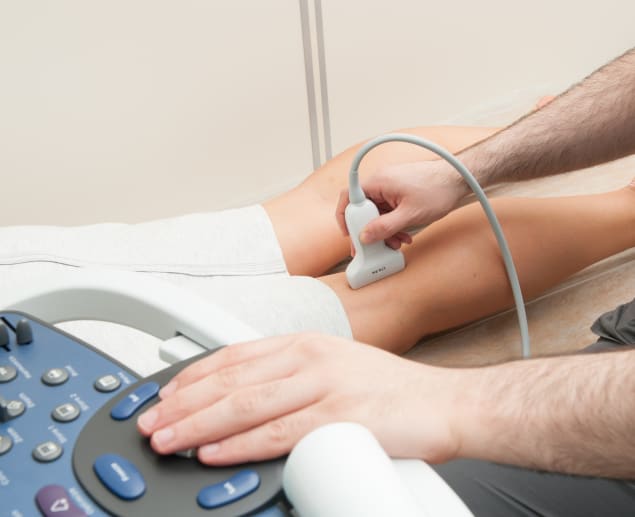
During a DVT ultrasound, a clear, water-based conductor gel is applied to the skin of the leg. A small, handheld ultrasound probe, called a transducer, is then placed on the skin and gently moved over the area.
High-frequency sound waves are transmitted from the transducer through the conductor gel and into the skin. When sound waves encounter structures such as blood vessels, they produce echoes that are converted into black-and-white images and displayed on a nearby screen.
These images are saved, and a specialist doctor, called a radiologist, reviews them, looking for restricted blood flow, blood clots and other abnormalities.
Diagnosing Deep Vein Thrombosis
A DVT ultrasound is conducted by a health professional called a sonographer. You may have other tests, including blood tests, at the same time or in a different department.
-
Clinical Assessment - Your sonographer will ask you questions about your symptoms, medical history, current health and lifestyle. They’ll also examine your leg for visible signs of redness and swelling.
-
Wells Score - They’ll then calculate a Wells Score, a set of criteria used to assess your risk of DVT based on factors such as level of leg swelling, any recent long spells of inactivity and a history of blood clots.
-
D-Dimer Test - You may have a blood test that looks for the presence of a substance called D-dimer, a protein fragment that builds up in the blood when blood clots form and subsequently break down.
-
Compression Ultrasound - You’ll be asked to lie on a bed while your sonographer applies the conductor gel and uses the transducer to apply pressure and create images of the veins deep inside your legs.
-
Duplex Ultrasound - While you’re in the same position, they’ll use the same transducer to take images of your veins using Duplex ultrasound technology.
-
Repeat Ultrasound (if needed) - If required, your sonographer will repeat the ultrasound process again.
-
Contrast Venography (if needed) - If your ultrasounds have proved inconclusive, you may have a venogram. During a venogram, a dye is injected into the affected vein to make blood clots more visible, and the area is then scanned with an X-ray.
-
CT Venography (if needed) - In some emergency cases, when a pulmonary embolism is suspected or when a blood clot is thought to be affecting a vein in the pelvis that might not show up on an ultrasound, a dye is injected into a suspect vein, and the area is scanned using CT technology. A CT is quick, but it uses radiation.
-
MR Venography (if needed) - As above, but if CT is considered inappropriate, MRI is used, as it doesn't involve radiation. However, an MRI scan takes longer than a CT scan.
Differential Diagnosis
In some cases, deep vein thrombosis may produce symptoms similar to those caused by other conditions, such as:
-
Chronic venous insufficiency (a condition that causes blood to pool in the lower legs and ankles due to damaged valves preventing the return of blood to the heart)
-
Muscle and tendon tears
-
Infections such as cellulitis
-
A ruptured cyst originating in the knee
-
Other causes of obstructions to blood flow, such as a tumour or leg injury
If you have pain, swelling or inflammation in your legs, and you’re unsure of the cause, speak to your GP, or book a DVT ultrasound to help you understand the cause of your symptoms.
Causes of DVT
Deep vein thrombosis is more likely if you have one or more of the risk factors mentioned above. DVT is also linked to being immobile for long periods of time, for example, due to:
-
Being confined to bed due to illness or injury
-
Recovery after surgery (both in hospital and at home)
-
Going on a long journey (three hours or more) by car, train, coach, boat or plane, where you can't get up and move around very easily
Being dehydrated, sitting for long periods of time, crossing your legs while you sit, being pregnant or having given birth within the previous six weeks are also thought to make DVT more likely.
Prognosis and Treatment
If you’re having a DVT ultrasound in an emergency situation because you have symptoms that need to be investigated urgently, you may be given a drug called heparin to thin your blood and help it flow better.
Once DVT is diagnosed, you’ll be given a different blood-thinning drug (usually warfarin) that you’ll need to take daily for at least three months. If a blood clot is particularly large or dangerous, you may need surgery to remove it. You may also have surgery to help prevent blood clots from forming again.
If you’ve had treatment for DVT, once you’ve been discharged from hospital, you can help your recovery by walking regularly and when you're at rest, keeping your affected leg raised on a cushion or pillow. It’s also recommended that you avoid long journeys for a couple of weeks after starting blood-thinning medications or having surgery for a blood clot.
Why an Ultrasound is a Good Option
If you're concerned about blood clots, a DVT ultrasound helps assess the health of your veins and blood flow. It may indicate that you’re at risk of developing DVT and can help you make lifestyle changes before you begin to notice symptoms.
Find an Ultrasound for DVT
Private scans are quick and easy at Scan.com. Choose from over 250 imaging centres across the UK and book your DVT ultrasound without the need for a referral from your GP. You’ll have your results in days, and you can choose to continue any care you need with one of our experts, or take your results to your NHS GP or private specialist.
If you're unsure if a DVT ultrasound is right for you, book a no-obligation consultation to discuss your symptoms and concerns.
FAQs
What Does a DVT Scan Show?
A DVT ultrasound highlights areas of restricted blood flow and blood clots within the deep veins, usually of the legs.
How Long Does a DVT Scan Take?
A DVT ultrasound takes around 30 to 60 minutes.
Is a DVT Scan Painful?
No, you won’t feel anything during a DVT ultrasound, but you may feel some discomfort as the ultrasound probe is pressed over the veins in the affected area.
How Accurate Is a DVT Ultrasound?
A DVT ultrasound is highly accurate at detecting blood clots and restricted blood flow and is considered the gold standard in both emergency and non-emergency settings.
References
Website, N. (2026, March 5). DVT (deep vein thrombosis). nhs.uk. https://www.nhs.uk/conditions/deep-vein-thrombosis-dvt/
Evans, J. R. (2019, November 15). What are the risk factors for deep vein thrombosis (DVT)? Healthline. https://www.healthline.com/health/dvt-risk-factors#risk-factors
Delgado, A. (2022, December 19). Everything you want to know about Deep vein thrombosis (DVT). Healthline. https://www.healthline.com/health/deep-venous-thrombosis